عeeb Meaning in Egypt: What You Can Say — and What You Shouldn’t Say
If you spend enough time in Egypt, you will eventually hear someone say:
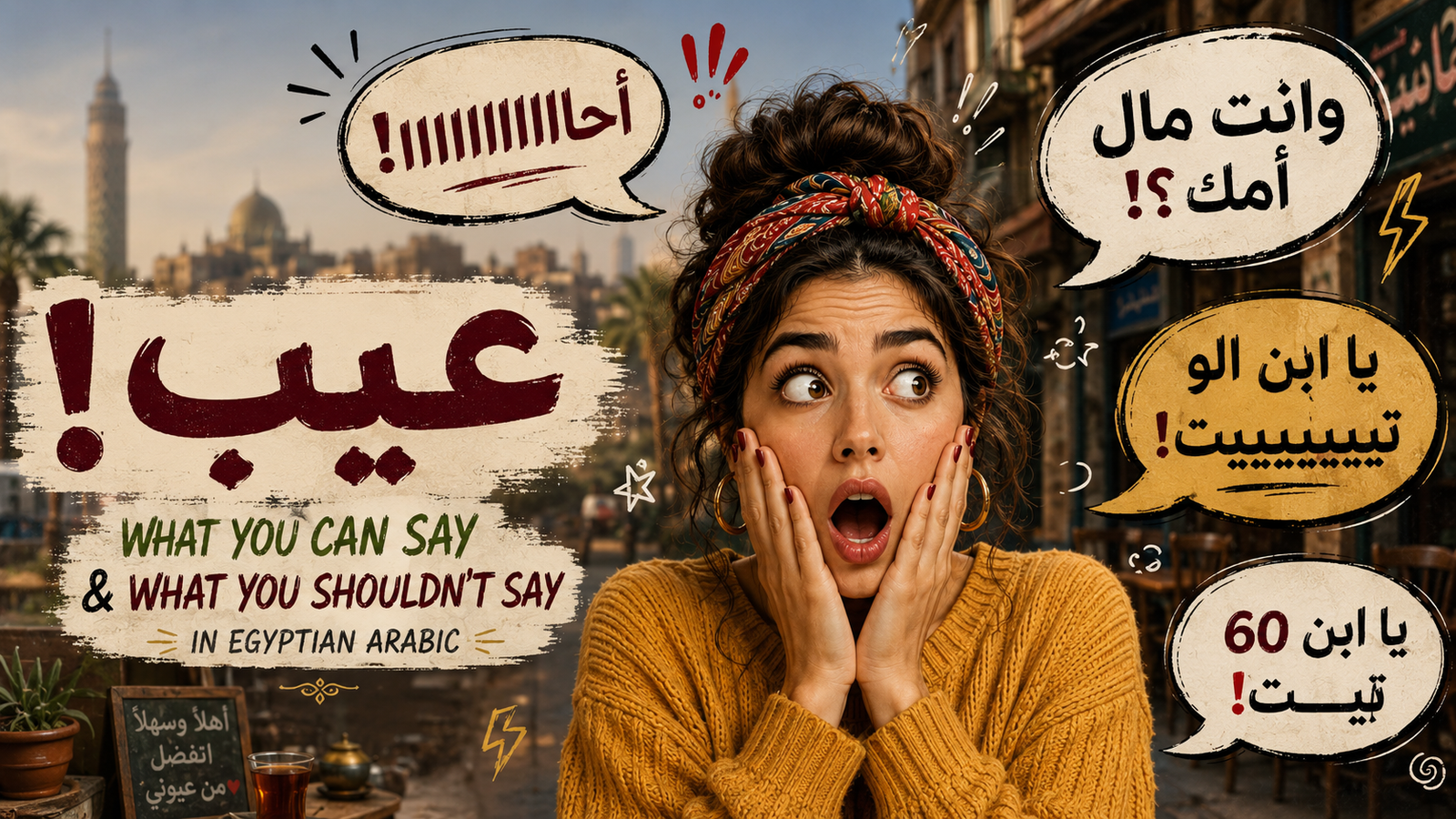
عيب!
عeeb!
You might hear a mother say it to her child. A friend might say it jokingly. Someone might say it after hearing a particularly inappropriate comment.
And sometimes, you might hear:
عيب عليك!
عeeb عaleek!
Depending on the situation, this can mean anything from “That’s not okay” to “Shame on you.”
But what does عeeb actually mean in Egyptian Arabic?
The simplest explanation is that عeeb describes something inappropriate, improper, shameful, or socially unacceptable. But the word means much more than any single English translation.
Egyptian social rules go far beyond one word.
There are things you can say to your best friend that you would never say in front of your grandmother. There are jokes that work perfectly between close friends but could sound extremely rude coming from a stranger. And there are questions that might feel very personal to a foreigner but seem perfectly normal to an Egyptian.
That’s where عeeb comes in.
Welcome to one of the most important—and least written—parts of Egyptian culture.
What Does “عeeb” Mean in Egyptian Arabic?
The easiest translations of عeeb are words like:
inappropriate, improper, shameful, or socially unacceptable.
But none of these translations captures the word perfectly.
In everyday Egyptian Arabic, عeeb often means something closer to:
“That’s not how you should behave in this situation.”
Imagine a child interrupts an older person.
The mother says:
عيب!
عeeb!
She isn’t necessarily saying that her child is a bad person.
She’s correcting a behavior.
The message is closer to:
“Don’t do that. It’s not appropriate.”
And that’s an important distinction.
عeeb Is Often About a Social Boundary
Who you’re talking to matters.
Where you are matters.
Your relationship with the other person matters.
Your age—and their age—may matter.
Something that is completely normal in one situation can suddenly become عeeb in another.
This is one reason understanding عeeb meaning requires more than simply translating the word.
Egyptian Etiquette: Context Changes Everything
This is one of the first things foreign learners discover when they start listening to real Egyptian Arabic.
You might hear two close friends insulting each other and laughing.
Then an older relative walks into the room.
Suddenly, the language changes.
Why?
Because the social relationship has changed.
Egyptian communication is often very sensitive to:
- Age
- Family relationships
- Respect
- Familiarity
- Social setting
- Privacy
- The level of closeness between people
So learning Egyptian Arabic isn’t only about asking:
“What does this word mean?”
You also need to learn:
“Who can I say it to?”
And sometimes:
“Can I say it at all?”
That’s one of the biggest differences between learning vocabulary and actually understanding a language.
Egyptian Swear Words: Understand Before You Use Them
Let’s talk about the elephant in the room.
Yes, Egyptians swear.
If you’re learning Egyptian Arabic from real conversations, movies, social media, or spending time in Egypt, you’re going to hear Egyptian swear words.
But here’s where language learners can get into trouble:
Hearing a word doesn’t mean you’re supposed to use it.
Some Egyptian insults can be used playfully between very close friends. Some depend heavily on tone and context. Others are extremely offensive and should never be treated as casual vocabulary.
The same expression can have completely different consequences depending on who says it, who hears it, and what their relationship is.
A close friend might say something outrageous to another close friend, and both people laugh.
The exact same words coming from a stranger can become a serious insult.
So when you hear Egyptians using strong language with each other, don’t automatically think:
“Oh, that’s a normal Egyptian word. I can use it too.”
You might be missing the most important part:
the relationship.
If you’re learning Egyptian slang, understanding when not to use an expression is just as important as knowing what it means.
Why Are Some Family-Based Insults So Serious?
One thing that surprises many foreigners is how strongly some Egyptian insults involve family.
An insult directed at someone’s mother, father, family, or honor can carry much more weight than an ordinary insult.
That’s why some expressions that sound almost funny or absurd when translated literally can be extremely offensive in actual use.
If an Egyptian friend teaches you one of these expressions and everyone starts laughing, that doesn’t necessarily mean the expression itself is harmless.
It may simply mean:
“We’re comfortable enough with each other to joke about this.”
That’s very different from saying it to someone you don’t know.
The Safest Rule?
Understand strong language before you ever try to use it.
You should absolutely know what you’re hearing.
But you don’t need to prove your Egyptian fluency by repeating every shocking expression you learn.
What Should You Avoid Saying in Front of Older People?
Another important part of Egyptian etiquette is understanding how language changes around older people.
You may notice that people become more careful with their language when an older family member enters the room.
Strong swear words?
Best avoided.
Sexual language?
Definitely not the time.
Insults involving someone’s parents or family?
Don’t experiment.
Very vulgar jokes?
Know your audience.
Of course, Egypt is a large and diverse society. Different generations, families, neighborhoods, and social groups have different expectations.
So there isn’t one universal Egyptian rulebook.
But as a general guideline:
The closer you are to someone’s family—and especially their elders—the more careful you should be with your language.
عeeb Isn’t Just About Words
Here’s where عeeb becomes much bigger than swear words.
Sometimes something can be considered عeeb because of what you do, not what you say.
For example:
- Interrupting someone older than you
- Speaking disrespectfully to someone’s parents
- Embarrassing someone publicly
- Being unnecessarily rude to a host
- Behaving too casually in a formal situation
- Refusing someone’s hospitality too bluntly
- Making certain jokes in front of family
- Asking a very personal question at the wrong moment
- Treating an older person exactly like a close friend
None of these are universal laws.
They’re examples of social expectations.
And that’s exactly what makes عeeb so interesting.
It isn’t simply a list of things that are “wrong.”
It’s a way of understanding what fits the situation.
Egyptian Hospitality Has Its Own Social Rules
Imagine you’ve been invited to an Egyptian home.
Your host offers you food.
You say:
“No, thank you.”
They offer again.
You say:
“Really, I’m full.”
They offer again.
And you’re thinking:
“I already said no three times!” 😂
Welcome to Egyptian hospitality.
Of course, not every Egyptian family behaves this way, and modern lifestyles are changing. But offering food, drinks, and hospitality remains an important part of Egyptian social life.
That’s why an extremely direct refusal can sometimes feel colder than you intended.
The same applies to other small social moments.
Arriving at someone’s home, interacting with older members of the family, accepting hospitality, or leaving without properly saying goodbye can all carry meanings you may not expect.
Again:
Context is everything.
Why Do Egyptians Ask Such Personal Questions?
Here’s another classic culture shock for foreigners in Egypt.
You meet someone for the first time.
Five minutes later, they might ask:
متجوز؟
metgawwez?
Are you married?
Then:
عندك أولاد؟
عandak awlad?
Do you have children?
And then:
بتشتغل إيه؟
beteshtaghal eh?
What do you do?
And you may be thinking:
“We literally just met.” 😂
For many foreigners, these questions can feel intrusive.
In Egypt, however, personal questions can sometimes be a way of showing interest, making conversation, or getting to know someone.
That doesn’t mean every personal question is acceptable.
Some subjects can absolutely be sensitive or inappropriate depending on the person and situation.
But the boundary between “personal” and “too personal” isn’t exactly the same in every culture.
So if an Egyptian asks you something that would feel unusual where you’re from, don’t automatically assume they’re trying to be rude.
They may simply be following a different social script.
What You Can Say to a Friend May Not Work With an Elder
Here’s one of the most useful rules to remember when learning Egyptian Arabic:
The words may stay the same. The relationship changes everything.
Imagine you learn a funny Egyptian expression from your friend.
You use it with your friend’s father.
Everyone goes silent.
Congratulations.
You’ve just learned something important about Egyptian Arabic.
Native speakers develop an instinct for the invisible rules of conversation.
They know:
- Who can joke with whom
- How far a joke can go
- Which expressions are playful
- Which expressions cross the line
- When a strong word is funny
- When it becomes an insult
As a language learner, you won’t automatically have that instinct.
And that’s completely normal.
It comes with time, observation, and experience.
So, What Is Actually “عeeb” in Egypt?
There isn’t a master list.
And that’s the point.
What is considered عeeb can depend on:
the people,
the place,
the age group,
the relationship,
the situation,
and sometimes even the mood.
Something might be perfectly normal between two friends but inappropriate at a family dinner.
Something might be funny in private but embarrassing in public.
Something might be harmless among young people but considered disrespectful by an older generation.
And something that’s completely normal in one Egyptian family might be unusual in another.
Egypt isn’t one giant rulebook.
It’s a society made up of different families, generations, communities, and social circles.
But عeeb is one of the words that helps you understand the idea behind all those unwritten boundaries.
The Most Important Rule for Learning Egyptian Arabic
If you’re learning Egyptian Arabic, don’t be afraid of strong language.
You should know what Egyptians actually say.
You should understand slang.
You should recognize swear words when you hear them.
You should know when someone is joking, teasing, insulting, or genuinely angry.
That’s all part of understanding real Egyptian Arabic.
But there’s a difference between:
Knowing a word
and
Knowing when to use it.
That second part takes experience.
So when someone teaches you a shocking Egyptian expression, your first question shouldn’t be:
“How do I pronounce it?”
It should probably be:
“Can I actually say this?”
Learning Egyptian Arabic Means Learning Egyptian Culture
Maybe that’s the real lesson behind عeeb.
Speaking Egyptian Arabic isn’t just about producing the right sounds or memorizing vocabulary.
It’s about understanding people.
Who you’re speaking to.
How close you are.
Where you are.
What the moment calls for.
And what your words might mean beyond their literal translation.
Because fluency isn’t only knowing what to say.
It’s knowing:
who to say it to,
when to say it,
how to say it,
and sometimes… when not to say it at all.
So go ahead.
Learn the slang.
Learn the jokes.
Learn the swear words.
Understand everything.
Just remember:
You don’t have to say everything you understand.
And if you’re ever unsure?
Watch what the Egyptians around you are doing first.
Because sometimes the smartest Egyptian phrase is simply:
عيب. 😄
Frequently Asked Questions About عeeb
What does عeeb mean in Egyptian Arabic?
عeeb is an Egyptian Arabic word used to describe something inappropriate, improper, shameful, or socially unacceptable. Its exact meaning depends heavily on the situation, relationship, and social context.
What does عeeb mean?
عeeb is another common way of transliterating عيب into English. You may see both عeeb and عeeb used online to describe the same Egyptian Arabic word.
Is عeeb a swear word?
Not necessarily. عeeb itself is not simply a swear word. It is commonly used to point out that someone’s behavior, words, or actions are inappropriate.
What does عeeb عaleek mean?
عeeb عaleek (عيب عليك) can mean something like “That’s not okay” or “Shame on you,” depending on the context and tone.
What things are considered عeeb in Egypt?
There is no single universal list. What is considered عeeb can depend on age, family relationships, social setting, familiarity, and the specific situation.
Can I use عeeb when speaking Egyptian Arabic?
Yes, but understanding the context matters. Like many expressions in Egyptian Arabic, the meaning and tone can change depending on who you’re speaking to and what is happening.
Why is understanding Egyptian etiquette important?
Learning Egyptian etiquette helps you understand the social meaning behind Egyptian Arabic. Knowing vocabulary alone isn’t enough; you also need to understand when an expression is appropriate and who you can use it with.